

For a home stretching station, start with the Sunny SF-BH621002 if you want a relatively narrow frame and a simple pivoting seat. Pick the Nitrofit Limber Pro if several people will share the machine or you specifically want a sliding seat and a separate calf board. Consider Precor’s StretchTrainer if you want a commercial-style station and have confirmed the exact model, delivery and room it needs.
As an Amazon Associate, we earn from qualifying purchases. We may earn a commission from links on this page.
Updated 10 November 2026. Recommendations are based on current manufacturer documentation and checked US listings. Prices and availability can change.
These are seated stretch trainers. They give you handles and a supported position from which to control the range yourself. The old list mixed these machines with an inversion table, a spinal traction device and a split stretcher. Those products work differently and solve different buying problems. This guide focuses on equipment for a general stretching routine, with alternatives for readers who do not need a full machine.
Compare the three options
Swipe to compare all columns on smaller screens. Specifications are from the manufacturers; verify your exact offer and installation requirements.
| Trainer | Best for | Published size (L × W) | Key feature |
|---|---|---|---|
| Sunny SF-BH621002 | Narrow home setup | 42.1 × 18.9 in | Pivoting seat; 265 lb limit |
| Nitrofit Limber Pro | Shared use and calf stretching | 50.5 × 22.4 in in manual | Sliding seat; 300 lb with required support |
| Precor StretchTrainer | Dedicated or shared station | 60 × 36 in, current VBR6240 | Check model and delivery with manufacturer |
Amazon bestsellers: stretching machines
The automatic bestseller list below is separate from our three editorial comparisons. Check the model and configuration before ordering from the list.

- 【FULL BODY STRETCHING MACHINE】Incorporate stretch bands, a foam roller, a pivoting seat, and a...
- 【MULTI-GRIP HANDLES】The multi-use handlebar lets you focus on specific muscle groups for effective...

- Total Body Stretch Equipment: Transform your flexibility and wellness routine with the Fairgom stretch...
- Sturdy Construction & Safety Wrist Strap: Built with a robust steel frame supporting up to 260 pounds, it...

- 【Exercise for Everyone】: Our leg stretcher machine can be used with confidence whether you are an...
- 【Durable & Comfortable】:Rigel Leg stretcher is unique from other models. The premium steel...

- 🟢 ADJUSTABLE SEAT: All other machines utilize a fixed-seat design that forces users into a...
- 🟢 LARGE INSTRUCTIONAL PLACARD: 9 illustrated stretches are displayed clearly on the large handlebar...

- TOTAL BODY FLEXIBILITY: Full body stretching equipment designed to unlock flexibility, release muscle...
- ENHANCED COMFORT DESIGN: Features cushioned seat, padded knee rests, and versatile multi-grip handles for...
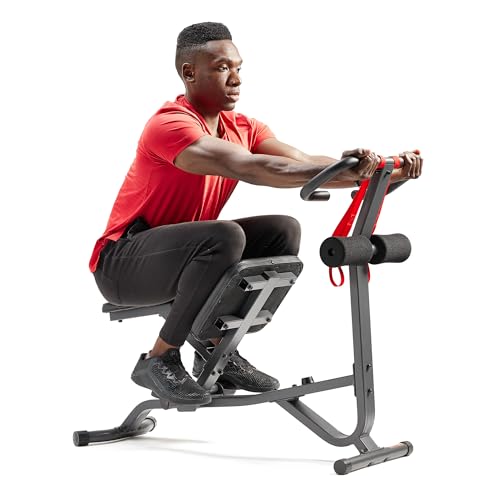
Sunny SF-BH621002: the compact choice for one room
Check Sunny SF-BH621002 on Amazon
Manufacturer specifications and model documentation
Sunny’s SF-BH621002 makes sense when the machine has to share a room with other equipment. Sunny lists its footprint as 42.1 inches long by 18.9 inches wide, with a height of 34.9 inches and a maximum user weight of 265 pounds. The brand describes the assembled unit as roughly 30 pounds. The narrow width helps when you have a strip of floor next to a bench, but you still need space on the side you use to step onto the seat and room around the moving parts.
The seat pivots while you hold the handles. Grip choices let you change position, and padded rollers and straps are part of the design. Sunny publishes a position guide alongside the assembly instructions. Read that guide before buying if you already know which movements you want to use. The handle you can reach comfortably and the point from which the seat starts matter more than the advertised number of stretches.
The main limitation is that the pivoting seat does not give you the Nitrofit’s sliding seat adjustment. If two people of very different sizes will use it, ask both to compare the geometry with a similar machine in a gym or showroom where possible. A comfortable fit for one person does not tell you whether another can reach the handles with their shoulders relaxed. If you must choose online, check the returns policy and how a partially assembled machine must be packed.
This pick is best for someone who wants a fixed place to do a short sequence and values a frame that is easier to move than a commercial station. It is less compelling if your only priority is a calf stretch or if you plan to carry it through stairs after every use. Moving an awkward frame safely is different from lifting its published weight as a single compact object.
Nitrofit Limber Pro: more ways to set the starting position

Check Nitrofit Limber Pro on Amazon
Manufacturer specifications and model documentation
Nitrofit differentiates the Limber Pro with a sliding seat that locks in place. Its manual documents seven seat positions and a removable calf board for standing stretches. The ability to move the seat closer to or farther from the handles changes where you start the movement; that is a practical feature if one person has short reach and another needs more distance. Start by making sure the seat is locked before entering or using the machine.
The manual gives an assembled size of approximately 50.5 by 22.4 by 38.5 inches and lists a 300-pound limit with the bracket support foot installed. Confirm which components are required for the exact model sold and follow the manual; the limit is tied to that installation condition. Add usable approach space on the side and in front of the calf board. If the front faces a wall, you may have space for the frame but no safe way to use that part of the machine.
The calf board has an adjustable incline. That matters if you want the board and the trainer in one place rather than buying a separate wedge. It can be removed as directed when you need a smaller storage envelope. A removable part is not the same as a folding machine, though. If storage is your main reason for choosing it, measure what still has to fit after removing the board and decide where the loose part will live.
Pay the difference over the Sunny if you will use the adjustment or board. If a single fixed setup already fits and a separate standing calf stretch works for you, the smaller Sunny makes more sense. Compare what the seller includes in the box with the manufacturer diagrams so you do not mistake an incomplete used unit for a like-for-like offer. Check the lock, support foot and board assembly before putting weight on any of them.
Precor StretchTrainer: for a dedicated station
Manufacturer model details and purchase inquiries
Precor’s current US product page identifies its commercial-style StretchTrainer as VBR6240 and lists dimensions of 60 by 36 by 40 inches with a 300-pound maximum user weight. Older Precor sheets and used 240i listings may show other dimensions or limits. Use the model number and serial information for the actual unit. If a seller describes one product as both a legacy 240i and the current VBR6240, ask which frame and documentation it is supplying before choosing the model on a floor plan.
This is a comparison for someone who wants a permanent, shared stretching station and can accommodate the footprint. Padded handles and a position placard help you use the machine without placing an extra screen in front of it. The appeal is the arrangement and accessibility of those features. If several people will use it, ask who will inspect and maintain the machine and check the seller’s support route for worn pads or missing parts.
We did not verify an exact current Amazon offer for this unit. The manufacturer page is a specification and purchase inquiry reference, not a claim of stock or delivery time. If buying through a dealer, request an exact model and delivery quote, confirm whether it arrives assembled, and ask what happens if it cannot pass through the doorway. For a used machine, inspect the frame and moving parts rather than buying solely because you recognize the brand from a gym.
The Precor is difficult to justify in a room where it crowds out the other exercises you want to do. If the smaller units fit your reach and routine, the additional floor area is a real cost even before purchase. Conversely, if a dedicated area already exists and the Precor is the one you can try locally, a fit check in person is worth more than a feature comparison on paper.
Which type of stretching equipment should you buy?
A supported station for several positions
A seated trainer is useful when your routine uses different positions and you want a consistent handle and seat to start from. You are buying convenience and a repeatable setup. A pivot or rail can help you change position without moving to another piece of equipment, but it does not make any given stretch appropriate for every user. Look for a position diagram that shows the actual machine, with clear instructions for how to get in and out.
Think through the sequence you expect to perform most often. If you would use the station for hips, hamstrings and shoulders, see how the manufacturer instructs you to change between those positions. A larger machine becomes easier to justify when several movements you already do benefit from the same setup. If the diagram covers many positions you will never use, count the ones that matter to you instead.
A leg spreader for a specific split goal
A seated stretch trainer and a split stretcher do not move the legs in the same way. A split stretcher holds the legs out to the sides and is a specialist tool for a particular training goal. The ability to wind the legs wider does not show whether that range is suitable for you, and the machine may not support an easy exit at every setting. Check the controls, release method and instructions carefully if that is the tool you meant to buy.
For general mobility work, pick the supported station only if it matches the positions you already plan to practice. If your goal is a particular martial arts or dance movement, ask your coach whether a machine belongs in that program. Training control and strength through a range is a separate decision from how far a machine lets you move. Do not use a machine’s end stop as a personal flexibility target.
A strap, mat or calf wedge if you only need one thing
You do not need a dedicated trainer for many common stretches. A strap can extend your reach in an appropriate floor exercise, a mat gives you a defined place to work, and a suitable calf wedge takes up less space than a seated station. Check whether you can get into and out of a floor position comfortably before buying based solely on cost. If floor access is inconvenient, a supported machine or a suitable chair-based routine may be more practical.
A useful trial is to use the equipment you already have for a week and note the part of the routine you repeatedly skip. If the obstacle is getting onto the floor, compare access and seat height. If it is holding a calf position, compare a simple wedge first. If you skip the routine because it is hard to make time for it, another large piece of equipment will not necessarily change that. Buy the feature that addresses a real obstacle.
Fit, placement and assembly checks before ordering
Test the entry and exit, not just the reach
The grip, seat and foot positions need to work together. A handhold that is reachable while you sit upright may be awkward once the seat pivots. Ask for measurements or try the machine at an easy position. Check whether you can enter and leave without holding the seat in place or relying on a moving handle for support. If you need assistance to transfer, consult someone who understands your mobility needs before relying on a product photo.
Measure the clear area around the front and sides, then mark the full area with tape. Include the approach path and the position of any calf board. Open drawers, doors and other equipment while the outline is on the floor. Do not set a machine next to a hard corner where you would have to twist to exit. Leave enough room to inspect the hardware and clean under it without dragging it each time.
Check the capacity and all required hardware
User capacity applies under the manufacturer’s specified conditions. Nitrofit’s support foot is one example of why the conditions matter. Do not use an old sales listing as a substitute for the instructions on a used or revised model. With a secondhand purchase, ask whether the manual and all original fittings are included. A loose bolt, worn strap or missing locking part should be addressed before the machine is used.
Use the recommended surface, position the frame as directed and check whether it rocks before loading it. Use the specified hardware and tightening sequence. Revisit the installation instructions if you move the trainer to another floor. If the seat, lock or handle moves in a way the manual does not describe, stop and resolve it instead of compensating by changing your body position.
How to approach the first few sessions
Start by reading the machine’s position guide without sitting on it. Learn how the seat moves, where your feet go, and how to return to the starting position. Check that adjustable parts are seated or locked. Choose a position you already understand and work through a small, comfortable range. If the movement makes you brace hard with your hands just to stay in place, reset the machine or choose a different position.
The Mayo Clinic stretching guide recommends warming up with light activity, moving smoothly and avoiding bouncing or painful stretches. If a position produces pain, back off. Ask a qualified clinician about equipment and positions if you are recovering from an injury, have a condition that affects movement, or have been given restrictions. A consumer machine cannot establish what is appropriate for your condition.
Make the setup repeatable. Record the seat setting, board angle or hand position that works for you. If two people share the unit, keep separate notes rather than assuming that the last setting is right for the next user. Review the instructions when you change positions. A useful session should leave you able to get out of the machine normally; reaching the most extreme position on the placard is not the objective.
For a broader home setup, our stall bars comparison covers a wall-mounted support format. A stall bar needs suitable structural mounting and leaves the choice of position to you, whereas a seated trainer puts the seat and handles in a fixed relationship. The right choice depends on where you want support and whether you need the floor area for other activities.
Frequently asked questions
Which stretching machine takes up the least space?
Of the three compared here, the Sunny has the smallest published footprint. Measure approach space as well as the frame. A narrow machine against a wall may be harder to use than a wider machine positioned where you can step onto it comfortably. Before buying, mark both the equipment and the space your body needs around it.
Is the Nitrofit worth paying more for?
It makes the strongest case if the adjustable seat solves a real fit issue or if you will use the calf board regularly. If one person will use the machine, has comfortable reach on the Sunny, and does calf stretches elsewhere, there is less reason to buy the larger frame. Confirm the exact package and support hardware first.
Can I buy a used Precor 240i based on the current specs?
Use the documentation for the unit on offer. Precor’s current VBR6240 page and older 240i materials do not list identical dimensions. Verify the model and serial details, measure the unit, and ask about delivery and replacement parts. Treat a photo of a similar StretchTrainer as a clue, not as confirmation of the exact frame.
Is an inversion table the same as a stretching machine?
No. An inversion table changes the orientation of your body, while these seated trainers use a seat, handles and body positioning to guide a stretch. Choose by the movement you want to perform. If you are shopping for symptom relief or a rehabilitation device, ask a qualified clinician rather than treating an inversion table, traction device and seated trainer as interchangeable.
Can I use a seated trainer if I cannot reach its handles easily?
Only buy one if you can get into the intended positions and return to the start without overreaching. An adjustable seat may help, but a pivoting mechanism and straps do not solve every fit issue. Ask the manufacturer for measurements or try the model locally. If neither is possible, a simple tool with an easier return policy may be a better starting point.
What should I check on delivery?
Match the model number to the order, inspect the frame and pads, and inventory all hardware before assembly. Verify locking points and support feet against the manual. Keep the packaging until you know the trainer fits, and test getting on and off before adding range. Report missing or damaged parts before using it.
Which one should I buy?
Choose Sunny for a narrow home station, Nitrofit for more adjustment or an included calf board, or Precor for a verified commercial-style installation. If you only need one stretch, try an appropriate small tool first. Measure the room, confirm the fit and check the exact seller’s terms before choosing.
This article was last updated on November 10, 2026 .


