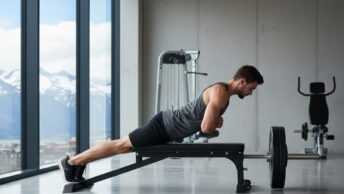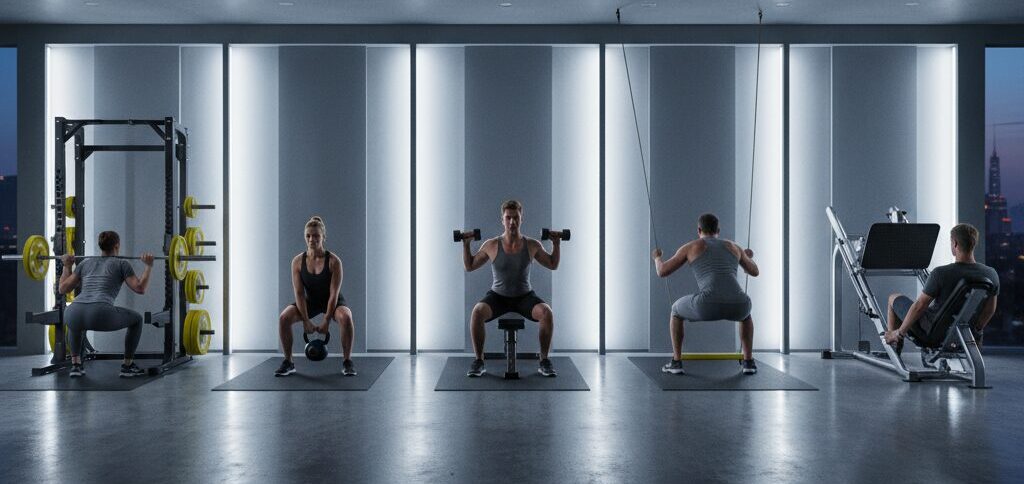
The hack squat machine is a staple in many commercial gyms, and for good reason. It isolates the quads effectively, reduces spinal loading compared to a barbell squat, and allows you to push serious weight with a guided range of motion. But what happens when the machine is taken, you train at home, or your gym simply doesn’t have one? That’s where knowing the best hack squat alternatives becomes genuinely useful.
Whether you’re looking to replicate the quad-dominant stimulus of the hack squat, work around a limitation, or simply add more variety to your leg training, there are several exercises that can deliver comparable results. If you’re building out a home setup, check out this guide on how to build a home gym on a budget to make sure you have the right equipment to perform these movements.
Key Takeaways
- The hack squat primarily targets the quadriceps with secondary activation of the glutes and hamstrings
- Several free-weight and machine-based alternatives can replicate the quad-dominant loading pattern
- The leg press, Bulgarian split squat, and front squat are among the most effective substitutes
- Proper foot placement and depth are critical for maximizing quad engagement in any alternative movement
- You don’t need a hack squat machine to build impressive leg strength and size
- Some alternatives also improve balance, stability, and unilateral strength that the machine version cannot
- Equipment availability and training goals should guide which alternative you choose
What Makes the Hack Squat Unique?
Before diving into alternatives, it helps to understand what you’re actually trying to replicate. The hack squat machine positions your back against a padded sled at roughly a 45-degree angle. Your feet are placed forward on a platform, which shifts the center of gravity and forces your knees to travel well over your toes. This mechanics create intense quadriceps activation, particularly in the vastus medialis (the teardrop muscle near the knee) and the rectus femoris.
The key characteristics of the hack squat include:
- Quad-dominant loading with reduced lower back involvement
- Fixed movement path that eliminates balance demands
- Deep knee flexion that creates a strong stretch and contraction in the quads
- Bilateral loading that allows heavy weight without spinal compression
A good alternative should replicate as many of these qualities as possible, depending on your available equipment and training context.
The 5 Best Hack Squat Alternatives
1. Leg Press
The leg press is arguably the closest machine-based alternative to the hack squat. Both exercises use a sled-style loading system, both allow you to push significant weight, and both minimize spinal loading. The key difference is the angle: on a leg press, you’re typically seated at a greater recline, but you can manipulate foot position to closely mimic hack squat mechanics.
How to maximize quad activation on the leg press:
- Place your feet low and narrow on the platform
- Allow your knees to travel forward over your toes
- Use a full range of motion, lowering until your thighs are at or below parallel
- Avoid locking out at the top to maintain constant tension
The leg press won’t challenge your balance or core the way free-weight alternatives do, but as a direct quad-building tool, it’s highly effective and easy to load progressively.
2. Front Squat
The front squat is one of the most underused exercises in recreational training, yet it closely mimics the biomechanics of the hack squat. Because the barbell is held in front of the body, your torso must remain upright, which places the knees forward and puts the quads under significant mechanical stress, much like the hack squat.
Why the front squat works as an alternative:
- Upright torso angle replicates hack squat mechanics
- Heavy loading potential for progressive overload
- Builds core stability and upper back strength simultaneously
- Develops the same quad sweep and teardrop definition
The front squat does require wrist flexibility and upper back strength to hold the bar in a front rack position. If that’s a limitation, a goblet squat or safety bar squat can serve as an easier entry point with similar benefits.
3. Bulgarian Split Squat
The Bulgarian split squat, also known as the rear-foot elevated split squat, is a single-leg exercise that delivers exceptional quad development while also addressing muscular imbalances between legs. When performed with a forward lean and the front foot placed slightly further out, it creates a deep stretch in the quad that rivals the hack squat in terms of muscle activation.
Benefits over the hack squat:
- Trains each leg independently, correcting strength imbalances
- Requires no machine or special equipment
- Develops hip flexor mobility and single-leg stability
- Can be loaded with dumbbells, barbells, or a trap bar
The Bulgarian split squat is harder to learn and more uncomfortable than machine-based options, but the payoff in terms of functional strength and hypertrophy is significant. Many coaches argue it’s one of the best lower body exercises available, period.
4. Goblet Squat
The goblet squat is often dismissed as a beginner movement, but it’s actually a highly effective quad builder when loaded appropriately. Holding a dumbbell or kettlebell at chest height naturally keeps the torso upright, mimicking the forward knee travel and quad emphasis of the hack squat.
How to get the most from the goblet squat:
- Use a heel elevation (plates or a wedge) to increase quad activation
- Squat as deep as your mobility allows
- Keep the weight close to your chest throughout
- Progress to heavier dumbbells or a double kettlebell variation time
The goblet squat is particularly useful for people who lack the barbell technique for front squats but still want that upright-torso, quad-dominant stimulus. Pair it with kettlebell exercises for a well-rounded lower body session.
5. Smith Machine Squat
The Smith machine squat often gets unfairly criticized, but when used intentionally, it’s a solid hack squat alternative. By placing your feet slightly forward of the bar and allowing the machine to guide the movement, you can replicate the forward knee travel and quad emphasis of the hack squat without needing the specific machine.
Tips for using the Smith machine as a hack squat alternative:
- Position feet 6 to 12 inches in front of the bar
- Keep your back against an imaginary wall (upright torso)
- Use a full range of motion
- Experiment with foot width to find what emphasizes your quads most
The Smith machine provides the same guided path benefit as the hack squat, making it a natural substitute in gyms that have one but lack a dedicated hack squat sled. For a deeper look at Smith machine training, explore the best Smith machines available for home and commercial use.
Comparison Table: Hack Squat vs. Alternatives
| Exercise | Equipment Needed | Quad Focus | Bilateral/Unilateral | Skill Level |
|---|---|---|---|---|
| Hack Squat | Hack squat machine | Very High | Bilateral | Beginner |
| Leg Press | Leg press machine | High | Bilateral | Beginner |
| Front Squat | Barbell | High | Bilateral | Intermediate |
| Bulgarian Split Squat | Bench + dumbbells/bar | High | Unilateral | Intermediate |
| Goblet Squat | Dumbbell/kettlebell | Moderate-High | Bilateral | Beginner |
| Smith Machine Squat | Smith machine | High | Bilateral | Beginner |
How to Choose the Right Alternative for You
Not every alternative will suit every lifter. Your choice should be guided by your training goals, available equipment, and current skill level.
| Goal | Best Alternative |
|---|---|
| Maximum quad hypertrophy | Leg press or front squat |
| Home gym training | Goblet squat or Bulgarian split squat |
| Fixing leg imbalances | Bulgarian split squat |
| Beginner-friendly option | Goblet squat or Smith machine squat |
| Athletic performance | Front squat or Bulgarian split squat |
| Minimal equipment | Goblet squat (with a single dumbbell) |
If your primary goal is building bigger quads, the leg press and front squat will give you the most direct carryover. If you’re training at home with limited equipment, the Bulgarian split squat and goblet squat are your best friends. And if you’re chasing athletic performance and functional strength, the front squat and split squat win out due to their balance and stability demands.
Programming Tips for Hack Squat Alternatives
Swapping out the hack squat doesn’t mean your programming needs to change dramatically. Here are some practical guidelines:
- Volume: Aim for 3 to 4 sets of 8 to 15 reps for hypertrophy-focused training
- Frequency: Train quads 2 times per week for optimal muscle growth
- Progressive overload: Increase weight, reps, or range of motion over time
- Pairing: Combine a bilateral quad exercise (leg press or front squat) with a unilateral option (Bulgarian split squat) for complete development
- Warm-up: Always include bodyweight squats and hip mobility work before loading
For additional lower body variety, plyometric exercises can complement your strength work by developing explosive power in the same muscle groups.
Conclusion
The hack squat is a fantastic exercise, but it’s far from irreplaceable. The five alternatives covered here, including the leg press, front squat, Bulgarian split squat, goblet squat, and Smith machine squat, can all deliver strong quad development when programmed and executed correctly. Some of them, like the Bulgarian split squat and front squat, may even offer advantages over the machine version in terms of functional strength and balance.
The key is understanding what the hack squat does mechanically and choosing an alternative that replicates those qualities as closely as possible given your available equipment and goals. Train consistently, focus on progressive overload, and your legs will grow regardless of whether a hack squat machine is in the room.
Frequently Asked Questions
Is the leg press a good replacement for the hack squat?
Yes, the leg press is one of the closest machine-based substitutes for the hack squat. By placing your feet low and narrow on the platform, you can replicate the quad-dominant loading pattern of the hack squat very effectively.
Can I build big quads without a hack squat machine?
Absolutely. Exercises like the front squat, Bulgarian split squat, and leg press all provide significant quad stimulus. Consistent training and progressive overload matter far more than the specific machine you use.
What is the best hack squat alternative for home gym training?
The Bulgarian split squat and goblet squat are ideal for home gym training because they require minimal equipment. A single dumbbell or kettlebell is enough to perform both movements effectively.
Does the front squat really mimic the hack squat?
Yes, more closely than most people realize. The front rack position forces an upright torso, which drives the knees forward and places the quads under a very similar mechanical load to the hack squat.
How often should I train legs if I’m using hack squat alternatives?
Most people benefit from training legs two times per week with adequate recovery between sessions. This frequency allows enough volume for muscle growth while giving your joints and muscles time to recover.
This article was last updated on March 30, 2026 .