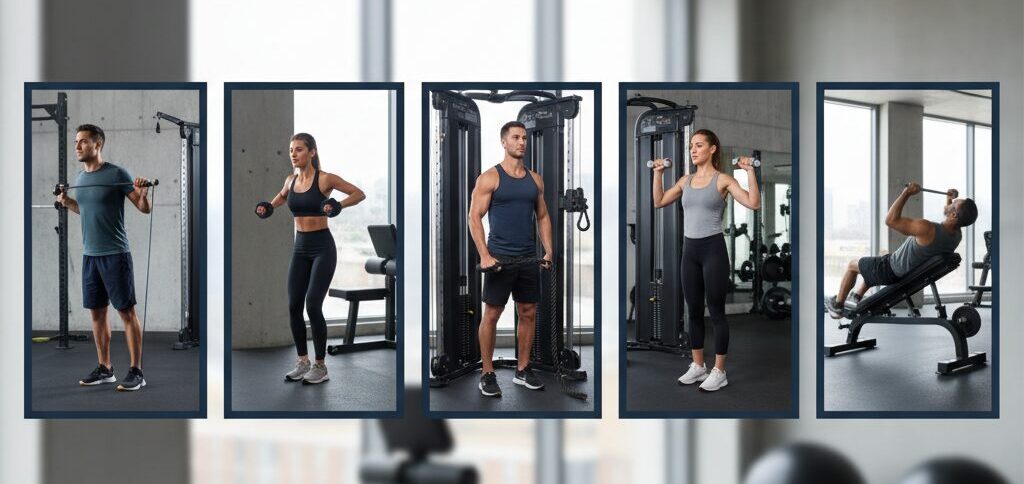
Face pulls are a staple in many well-designed training programs, and for good reason. They target the rear deltoids, rotator cuff muscles, and mid-trapezius in a way that few other exercises can replicate. But what happens when you don’t have access to a cable machine, or you simply want to add more variety to your shoulder and upper back training? That’s where face pull alternatives come in.
Whether you’re training at home, working around equipment limitations, or just looking to keep your program fresh, there are several exercises that can deliver the same posterior shoulder and upper back benefits. This guide breaks down the five best options, explains how to perform them correctly, and helps you decide which ones belong in your routine.
Key Takeaways
- Face pulls primarily train the rear deltoids, external rotators, and mid-traps, so the best alternatives target these same muscles
- Resistance bands, dumbbells, and cables all offer effective tools for replicating the face pull movement pattern
- Rear delt and rotator cuff training is essential for shoulder health, posture, and injury prevention
- Most of these alternatives can be done at home with minimal equipment
- Incorporating two or three of these movements into your weekly routine can significantly improve shoulder stability and upper back strength
- more than load when training the rear delts and rotator cuff
Why Face Pulls Matter (and When You Need an Alternative)
Before diving into the alternatives, it’s worth understanding what makes the face pull so effective. The exercise involves pulling a rope attachment toward your face at roughly eye level, which creates a unique combination of shoulder horizontal abduction and external rotation. This dual action is what makes it so valuable for counteracting the internal rotation that comes from heavy pressing work, desk posture, and everyday life.
The rear deltoids are notoriously underdeveloped in most lifters because they don’t get much direct stimulation from common exercises like bench press or overhead press. Neglecting them can lead to shoulder imbalances, poor posture, and a higher risk of rotator cuff injuries over time.
If you’re building out a training space and want to explore equipment options, check out this guide on how to build a home gym on a budget for ideas on what tools give you the most versatility.
The 5 Best Face Pull Alternatives
1. Band Pull-Apart
The band pull-apart is arguably the closest alternative to the face pull in terms of muscle activation and movement pattern. It targets the rear delts, rhomboids, and mid-trapezius while also reinforcing proper scapular retraction mechanics.
How to perform it:
- Hold a resistance band at shoulder height with both hands, palms facing down
- Keep your arms nearly straight with a soft elbow
- Pull the band apart horizontally until it touches your chest
- Slowly return to the starting position with control
This exercise is incredibly accessible since all you need is a resistance band. It’s also easy to adjust intensity by using a lighter or heavier band, or by changing your grip width. Performing this movement with high reps (15 to 25 per set) works well for both warm-ups and accessory work.
If you’re looking to expand your band training beyond this movement, the 7 great resistance band exercises you should try covers a solid range of options for full-body development.
2. Dumbbell Rear Delt Fly
The dumbbell rear delt fly is a classic isolation exercise for the posterior deltoid. While it doesn’t replicate the external rotation component of the face pull, it provides excellent direct stimulation to the rear delt through a wide range of motion.
How to perform it:
- Hinge forward at the hips until your torso is roughly parallel to the floor
- Hold a dumbbell in each hand with a neutral grip, arms hanging down
- With a slight bend in the elbows, raise your arms out to the sides until they are parallel to the floor
- Squeeze the rear delts at the top, then lower slowly
A common mistake is using too much weight and allowing the traps to take over. Keep the load light enough to feel the rear delts working throughout the entire range of motion. This movement pairs well with pressing exercises and should be trained with moderate to high reps for best results.
3. Cable Rear Delt Fly (Low to High)
If you have access to a cable machine but can’t set it up for face pulls (or want a variation), the cable rear delt fly performed from pulley position is an excellent option. The constant cable tension throughout the movement makes it particularly effective for rear delt isolation.
How to perform it:
- Set the cable pulley to the lowest position
- Stand sideways to the machine and grab the handle with the far hand (cross-body grip)
- With a slight bend in the elbow, raise your arm in a wide arc from low to high
- Control the return and repeat for reps before switching sides
The low-to-high angle closely mimics the line of pull used in face pulls, making this one of the most mechanically similar alternatives on this list. If you’re interested in maximizing your cable machine work, the best cable exercises for a solid chest is worth reading alongside this to build a well-rounded upper body program.
4. Prone Y and T Raises
Prone Y and T raises are bodyweight-based alternatives that challenge the rear delts, lower traps, and rotator cuff without any equipment at all. They are often used in physical therapy and athletic performance settings because they train the scapular stabilizers through full range of motion.
How to perform it:
- Lie face down on a bench or the floor
- For the Y raise: extend your arms overhead at a 45-degree angle and lift them off the surface, squeezing the lower traps
- For the T raise: extend your arms straight out to the sides and lift them, focusing on the rear delts and mid-traps
- Hold each position briefly at the top before lowering with control
These movements are deceptively difficult. Most people find that even with no added weight, performing 10 to 15 clean reps is genuinely challenging. They are excellent for building the mind-muscle connection in the posterior shoulder and upper back.
5. Dumbbell External Rotation
The dumbbell external rotation is the most targeted exercise on this list for the rotator cuff, specifically the infraspinatus and teres minor. The face pull trains these muscles through the external rotation component of the movement, and this exercise isolates that action directly.
How to perform it:
- Lie on your side on a bench or the floor
- Hold a light dumbbell in your top hand with your elbow bent to 90 degrees, upper arm resting against your side
- Rotate your forearm upward as far as comfortable, keeping your elbow pinned to your side
- Lower slowly and repeat
This exercise requires very light weight. Most people use between 2.5 and 10 pounds depending on their shoulder health and training history. It’s not about building mass; it’s about strengthening the small muscles that protect the shoulder joint and support heavier pressing movements.
Comparison Table: Face Pull vs. Alternatives
| Exercise | Equipment Needed | Rear Delt Focus | External Rotation | Difficulty |
|---|---|---|---|---|
| Face Pull | Cable machine | High | High | Moderate |
| Band Pull-Apart | Resistance band | High | Moderate | Low |
| Dumbbell Rear Delt Fly | Dumbbells | High | Low | Low-Moderate |
| Cable Rear Delt Fly | Cable machine | High | Moderate | Moderate |
| Prone Y and (bench optional) | Moderate | Moderate | Moderate | |
| Dumbbell External Rotation | Dumbbell | Low | High | Low |
How to Program These Alternatives
| Goal Sets x Reps | Frequency | ||
|---|---|---|---|
| Shoulder health and injury prevention | Band pull-apart, Dumbbell external rotation | 3 x 15-20 | 3x per week |
| Rear delt mass and definitionelt fly, Cable rear delt fly | 3-4 x 12-15 | 2x per week | |
| Posture improvement | Prone Y and T raises, Band pull-apart | 3 x 10-15 | 3x per week |
| Balanced upper body development | Mix of all five | 2-3 x 12-20 | 2-3x per week |
Tips for Getting the Most Out of These Movements
- Prioritize control over load. The rear delts and rotator cuff respond better to controlled, full-range reps than heavy, sloppy sets.
- Train them consistently. These muscles are often undertrained, so frequency matters. Two to three sessions per week is ideal.
- Use them as accessory work. Place these exercises after your main compound lifts, not before.
- Warm up with them. Band pull-aparts and prone raises make excellent warm-up movements before any upper body session.
- Don’t neglect posture. These exercises are most effective when combined with good daily posture habits and regular mobility work.
For those who want to add more dynamic training alongside these movements, 8 plyometric exercises you need to add to your routine can complement your upper body work with athletic conditioning.
Conclusion
Face pulls are a genuinely excellent exercise, but they are far from irreplaceable. The five alternatives covered here, band pull-aparts, dumbbell rear delt flies, cable rear delt flies, prone Y and T raises, and dumbbell external rotations, collectively cover everything the face pull does and can be adapted to virtually any training environment.
The most important takeaway is that posterior shoulder and rotator cuff training not be optional in your program. These muscles protect your joints, improve your posture, and support every pressing and pulling movement you do. Whether you have a full cable setup or just a resistance band, there is no excuse to skip this work.
Choose one or two of these alternatives based on your available equipment, program them consistently, and you will notice improvements in shoulder stability, posture, and overall upper body balance within a few weeks.
FAQs
Are face pull alternatives as effective as the actual face pull?
Yes, when programmed correctly. While no single exercise perfectly replicates the face pull, combining two of these alternatives, such as band pull-aparts and dumbbell external rotations, covers the same muscles and movement patterns effectively.
Can I do these exercises at home without any equipment?
Prone Y and T raises require no equipment at all, and band pull-aparts only need a resistance band. Both are excellent home-friendly options that train the same muscles as the face pull.
How often should I train the rear delts?
Two to three times per week is generally recommended for the rear delts and rotator cuff, especially if you do a lot of pressing work. These muscles recover quickly and benefit from higher training frequency.
Why are my rear delts so hard to feel during exercises?
The rear delts are often difficult to isolate because the traps and rhomboids tend to dominate pulling movements. Focus on lighter weights, a controlled tempo, and initiating the movement from the back of the shoulder rather than the upper back.
Do these exercises help with shoulder pain?
Strengthening the rear delts and rotator cuff can help prevent and reduce certain types of shoulder pain, particularly pain related to muscle imbalances and poor posture. However, if you are experiencing acute or significant shoulder pain, consult a healthcare professional before starting any new exercise program.
This article was last updated on March 30, 2026 .