If you’re serious about building a strong, well-defined chest, you don’t need a commercial gym membership or an expensive cable machine to get there. Whether you’re working with minimal equipment or none at all, it’s entirely possible to build chest at home with the right approach, consistency, and programming.
In fact, many lifters are surprised by how effective bodyweight and home-based training can be for chest development when done correctly. If you’re setting up a dedicated training space, you might also want to check out how to build a home gym on a budget before diving in.
Key Takeaways
- You can build a strong, muscular chest at home using bodyweight exercises, resistance bands, dumbbells, or a combination of all three
- Progressive overload is just as important at home as it is in the gym — you need to keep challenging your muscles over time
- Push-up variations are the foundation of any home chest workout and can be modified to target different areas of the chest
- The upper, middle, and lower chest each respond to different angles, so varying your exercise
- Adding equipment like adjustable dumbbells or resistance bands significantly expands your exercise options and acceler, nutrition, and sleep are just as critical as the workouts themselves
- Consistency over weeks and months is what actually produces visible chest development
Understanding Chest Anatomy First you start programming your home chest workouts, it helps to understand what you’re actually training. The chest is made up of two primary muscles:
- Pectoralis major: The large, fan-shaped muscle that makes up the bulk of the chest. It has an upper portion (clavicular head) and a lower portion (sternal head)
- Pectoralis minor: A smaller muscle that sits underneath the pec major and assists with shoulder movement
To fully develop the chest, you need to train it from multiple angles. Incline movements emphasize the upper chest, flat movements target the middle chest, and decline movements focus on the lower chest. Neglecting any of these angles leads to an uneven, underdeveloped appearance.
Bodyweight Chest Exercises for Home Training
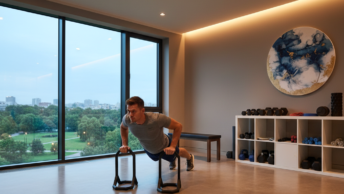
The push-up is one of the most underrated chest-building exercises in existence. Most people dismiss it as too basic, but when you apply progressive overload and use smart variations, push-ups can produce serious muscle growth.
Standard and Elevated Push-Up Variations
Flat push-ups are your baseline. They target the middle chest and build foundational pressing strength. Focus on keeping your elbows at roughly a 45-degree angle from your torso, not flared out wide.
Incline push-ups (hands elevated on a bench or chair) shift the emphasis to the lower chest. The higher the surface, the more lower chest activation you get.
Decline push-ups (feet elevated) are excellent for the upper chest. Placing your feet on a couch or chair increases the angle and recruits the clavicular head of the pec major more ag-grip push-ups** increase the range of motion across the chest, creating more stretch and tension in the pec fibers.
Diamond push-ups shift focus toward the triceps but still engage the inner chest significantly.
Advanced Bodyweight Progressions
Once standard push-up variations feel too easy, you can progress to:
- Archer push-ups: A unilateral variation that increases load on one side at a time
- Pseudo planche push-ups: Lean hands lower on the torso to dramatically increase chest and shoulder demand
- Ring push-ups or suspension trainer push-ups: If you have gymnastic rings or a TRX, these add instability that forces deeper muscle engagement
You can also explore 7 great dip bar exercises for additional chest-focused bodyweight movements that work well in a home setting.
Adding Equipment to Accelerate Results
While bodyweight training alone can take you far, adding even minimal equipment opens up a much wider range of exercises and makes progressive overload much easier to manage.
Resistance Bands
Resistance bands are one of the most cost-effective tools for home chest training. They allow you to perform chest flyes, standing chest presses, and cable-style crossovers without any heavy machinery. The variable resistance (bands get harder as they stretch) also provides a unique training stimulus that complements bodyweight work well. Check out these 7 great resistance band exercises to get started with band-based training.
Adjustable Dumbbells
A quality set of adjustable dumbbells is probably the single best investment you can make for home chest training. With dumbbells, you can perform:
- Dumbbell bench press (flat, incline, decline)
- Dumbbell chest flyes
- Dumbbell pullovers
- Single-arm variations for additional core demand
The ability to change weight quickly and incrementally makes progressive overload straightforward, which is critical for long-term muscle development.
A Weight Bench
A weight bench transforms your home training significantly. Even a basic flat bench allows for proper dumbbell pressing mechanics. An adjustable bench adds incline and decline options. Take a look at the best home weight benches if you’re considering adding one to your setup.
Sample Home Chest Workout Programs
Here are two structured home chest workouts, one using only bodyweight and one using dumbbells and bands.
Bodyweight-Only Chest Workout
| Exercise | Sets | Reps | Rest |
|---|---|---|---|
| Decline Push-Ups (upper chest) | 3 | 12-15 | 60 sec |
| Standard Push-Ups | 3 | 15-20 | 60 sec |
| Incline Push-Ups (lower chest) | 3 | 12-15 | 60 sec |
| Wide-Grip Push-Ups | 3 | 12-15 | 60 sec |
| Diamond Push-Ups | 2 | 10-12 | 60 sec |
Dumbbell and Band Chest Workout
| Exercise | Sets | Reps | Rest |
|---|---|---|---|
| Dumbbell Flat Press | 4 | 8-12 | 90 sec |
| Dumbbell Incline Press | 3 | 10-12 | 90 sec |
| Dumbbell Chest Fly | 3 | 12-15 | 60 sec |
| Resistance Band Crossover | 3 | 15-20 | 60 sec |
| Decline Push-Ups (finisher) | 2 | To failure | 60 sec |
Progressive Overload: The Non-Negotiable Principle
No matter what exercises you choose, progressive overload is the engine behind muscle growth. Without it, your chest will adapt to the stimulus and stop growing. Here’s how to apply it at home:
- Increase reps: If you can do 15 clean push-ups, aim for 17 next week
- Increase sets: Add an extra working set once your current volume feels manageable
- Progress to harder variations: Move from standard push-ups to decline or archer push-ups
- Add resistance: Use a weighted vest, resistance bands, or heavier dumbbells
- Reduce rest periods: Shortening rest increases metabolic stress on the muscle
- Increase time under tension: Slow down the lowering phase to 3-4 seconds per rep
Tracking your workouts in a simple notebook or app is one of the most effective habits you can build. If you don’t know what you did last week, you can’t beat it this week.
Common Mistakes That Limit Chest Development at Home
Training only one angle: Doing nothing but flat push-ups will develop the middle chest while leaving the upper and lower portions underdeveloped. Rotate through all angles in every session or across your weekly programming.
Neglecting the stretch: The chest responds particularly well to exercises that take it through a full range of motion. Rushing through reps with a shortened range limits muscle fiber recruitment and long-term growth.
Skipping recovery: Muscle is built during rest, not during the workout itself. Training chest every day without adequate recovery is counterproductive. Two to three chest-focused sessions per week with rest days between them is optimal for most people.
Ignoring nutrition: You can train perfectly and still fail to build muscle if your diet doesn’t support it. Protein intake is especially important. Aim for at least 0.7 to 1 gram of protein per pound of bodyweight daily. After your sessions, prioritize the best post-workout meals for muscle gain to support recovery and growth.
Poor mind-muscle connection: Research consistently shows that actively thinking about the muscle you’re training during a set increases activation. Slow down, feel the chest working, and stop treating push-ups as something to rush through.
How Long Does It Take to Build Chest at Home?
This is the question most people want answered immediately, and the honest answer is: it depends. With consistent training, progressive overload, and solid nutrition, most people begin to notice visible chest development within 8 to 12 weeks. Significant changes in size and definition typically take 4 to 6 months of dedicated effort.
Beginners often see faster initial progress because the neuromuscular adaptations in the first few weeks are substantial. Intermediate and advanced trainees need more time and more deliberate programming to continue progressing.
The key is to stop looking for shortcuts and focus on the process. Show up, train hard, eat well, sleep enough, and the results will follow.
Conclusion
Building your chest at home is not only possible, it can be remarkably effective when you approach it with the right strategy. Start with the fundamentals: master push-up variations, apply progressive overload, train all angles of the chest, and recover properly. If your budget allows, adding adjustable dumbbells, a weight bench, or resistance bands will meaningfully accelerate your progress. The gap between home training and gym training is much smaller than most people believe, especially when you train with intention and consistency. Stick with it, track your progress, and trust the process.
FAQs
Can you really build a big chest without going to the gym?
Yes, absolutely. Bodyweight exercises like push-up variations and dips, combined with resistance bands or dumbbells, can produce significant chest muscle growth. The key is applying progressive overload consistently over time, just like you would in a gym.
How many push-ups should I do to build chest muscle?
The number matters less than the challenge. You should be working close to muscular failure within a rep range of 8 to 20. If you can easily do 30 push-ups, it’s time to progress to a harder variation or add resistance.
How often should I train my chest at home?
Two to three times per week is optimal for most people. This allows enough training frequency to stimulate growth while giving the muscle tissue adequate time to recover between sessions.
Do I need a bench to build my chest at home?
No, but it helps. A bench allows for better pressing mechanics and incline or decline angles with dumbbells. You can substitute a couch, chair, or the floor for many exercises if you don’t have one yet.
Why is my upper chest not developing?
Upper chest development requires incline pressing movements. If you’re only doing flat push-ups or flat dumbbell presses, the upper chest (clavicular head) won’t get enough direct stimulation. Add decline push-ups (feet elevated) and incline dumbbell presses to address this.
This article was last updated on April 20, 2026 .