The deadlift is one of the most commonly discussed exercises in strength training, but it also attracts a fair amount of confusion, especially when people mix it up with other barbell lifts. One question that comes up surprisingly often is whether the deadlift requires you to drive the bar overhead quickly.
This mix-up usually happens when people are new to weightlifting terminology or are trying to understand the differences between powerlifting movements and Olympic lifts. Clearing this up is important for training safely and choosing the right exercise for your goals.
Quick Answer
No, the deadlift does not require you to drive the bar overhead quickly. The deadlift is a strength exercise where you lift a loaded barbell from the floor to a standing position, stopping at hip height. The bar never goes overhead. Lifts that involve driving a bar overhead quickly, such as the clean and jerk or snatch, are Olympic weightlifting movements.
Key Takeaways
- The deadlift ends at hip level, not overhead
- Driving a bar overhead quickly is a characteristic of Olympic weightlifting, not powerlifting
- The deadlift is a slow, controlled strength movement focused on maximum load
- Confusing the deadlift with Olympic lifts is a common beginner mistake
- Each type of lift has distinct technique requirements, muscle demands, and training purposes
- Choosing the right lift depends on your goals, training experience, and equipment
What Does the Deadlift Actually Involve?
The deadlift is a compound barbell exercise where you pull a loaded bar from the floor to a fully upright standing position. The movement ends when your hips and knees are fully extended and your shoulders are pulled back. At no point does the bar travel above the hips in a standard deadlift.
The three primary deadlift variations include:
- Conventional deadlift: feet hip-width apart, hands outside the legs
- Sumo deadlift: wide stance with hands inside the legs
- Romanian deadlift: starts from standing, hinging at the hips with a slight knee bend
All three variations share the same fundamental endpoint: the bar stays at hip level. Speed is not a primary goal. Controlled tension and maximal load are.
If you want to understand more about the specific equipment used for this lift, including how bar flex and knurling affect your performance, this guide on the deadlift bar breaks it down in detail.
Which Lifts Actually Require Driving the Bar Overhead Quickly?
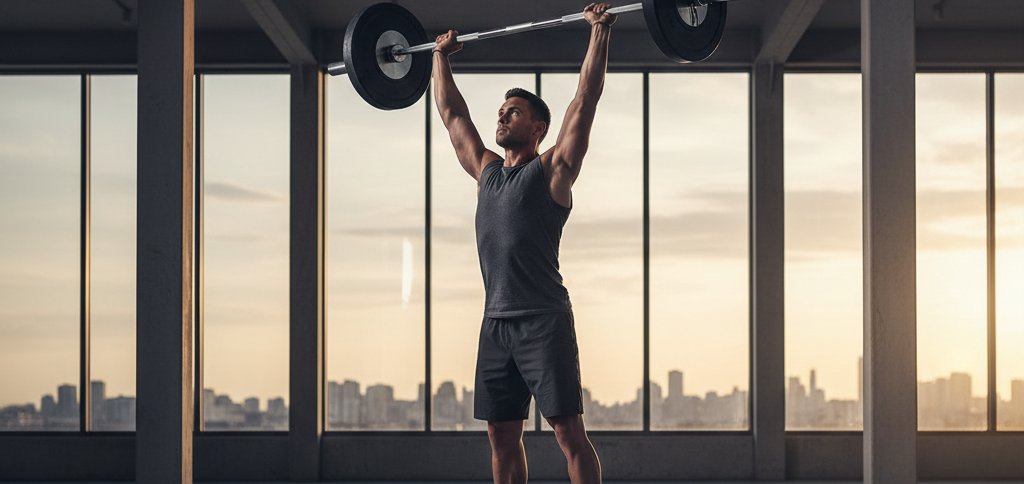
The lifts that involve moving a barbell overhead with speed and power are Olympic weightlifting movements. These are technically demanding, athletically driven lifts that require explosive hip extension, timing, and coordination.
The two main Olympic lifts are:
- The Snatch: The bar travels from the floor to fully overhead in one continuous movement
- The Clean and Jerk: The bar is first pulled to the shoulders (the clean), then driven overhead in a second explosive movement (the jerk)
These lifts are not just “fast deadlifts.” They involve completely different mechanics, bar paths, footwork, and technique requirements. If you want a deeper breakdown of how these movements differ, this article on clean and press vs clean and jerk is a great starting point.
Deadlift vs. Olympic Lifts: A Side-by-Side Comparison
| Feature | Deadlift | Clean and Jerk / Snatch |
|---|---|---|
| Bar endpoint | Hip height | Fully overhead |
| Speed requirement | Controlled | Explosive and fast |
| Primary goal | Maximum strength | Power and athleticism |
| Technique complexity | Moderate | High |
| Overhead component | None | Yes |
| Common in | Powerlifting | Olympic weightlifting |
This comparison makes it clear that these are fundamentally different movements with different purposes.
Why Do People Confuse the Deadlift With Overhead Lifts?
The confusion often stems from watching highlight clips of strength athletes or seeing edited workout videos where multiple movements are shown back to back. It can also happen when someone hears the term “power clean” or “deadlift high pull” and assumes the deadlift itself ends overhead.
The deadlift high pull is a variation where you pull the bar explosively toward your chin after the initial pull from the floor, but even this does not involve pressing or driving the bar fully overhead. It is a transitional drill often used to teach Olympic lifting mechanics, not a standard deadlift variation.
New lifters should also be aware that some functional fitness programs combine movements in ways that can blur the lines. Understanding each lift individually before combining them is key to building safe, effective technique.
Does the Deadlift Require Any Explosive Movement at All?
For standard strength training, the deadlift is typically performed with controlled effort rather than maximal speed. That said, some training protocols do use the deadlift explosively at submaximal weights to develop rate of force development.
Here is how speed intent varies by training goal:
- Maximal strength: Slow, grinding reps at heavy loads
- Power development: Lighter loads lifted as fast as possible (often called “speed deadlifts”)
- Hypertrophy: Controlled tempo with emphasis on the eccentric phase
Even in speed-focused deadlift work, the bar still stops at the hips. The explosive intent changes, but the range of motion does not.
For those training at home and looking to build strength without a full barbell setup, this guide on how to build your chest at home and this overview of quick workouts at home show how you can train effectively across multiple muscle groups without specialized equipment.
Should You Add Olympic Lifts to Your Training?
If your goal is building raw strength, the deadlift is more than sufficient. If you are interested in developing explosive power, speed, and athletic performance, Olympic lifts are worth learning, but they require proper coaching and progressive skill development.
Beginners are generally better served by mastering the deadlift before attempting any overhead barbell work. Once you have a solid foundation in hip hinge mechanics, bracing, and bar control, transitioning to more complex movements becomes much safer and more productive.
Pairing deadlifts with plyometric exercises is another effective way to build power without the technical demands of Olympic lifting. Similarly, kettlebell exercises like the kettlebell swing can bridge the gap between pure strength and explosive power development.
Conclusion
The deadlift does not require you to drive the bar overhead quickly. It is a controlled strength movement where the bar travels from the floor to hip height. Lifts involving rapid overhead bar movement belong to Olympic weightlifting and require entirely different technique and training progressions.
Understanding this distinction helps you train with better focus, avoid unnecessary injury risk, and choose the right movements for your specific goals.
FAQs
Does the deadlift work the same muscles as the clean and jerk?
There is some overlap, particularly in the posterior chain, but the clean and jerk also heavily recruits the upper body, traps, and requires significant shoulder mobility. The deadlift focuses more purely on the hamstrings, glutes, and lower back.
Can a deadlift transition into an overhead press?
Yes, some lifters perform a “deadlift to overhead press” as a combination movement, but this is a separate exercise, not a standard deadlift. Each phase is performed distinctly and at different loads.
Is the deadlift considered a power lift or an Olympic lift?
The deadlift is a powerlifting movement. It is one of the three competition lifts in powerlifting, alongside the squat and bench press. Olympic lifting consists of the snatch and the clean and jerk.
What is a deadlift high pull?
A deadlift high pull involves pulling the bar explosively from the floor toward the chin with bent elbows. It is often used as a teaching drill for Olympic lifting but is not a standard deadlift and does not involve pressing the bar overhead.
How heavy should you go on a deadlift compared to Olympic lifts?
Deadlift loads are typically much heavier than Olympic lift loads because the range of motion is shorter and speed is not required. Olympic lifts are usually performed at 50 to 80 percent of a lifter’s deadlift max.
This article was last updated on September 29, 2026 .