

As an Amazon Associate I earn from qualifying purchases. Product links below are affiliate links. Prices, availability and bundle contents can change; check the selected option before ordering.
The best bench press rack is the one that fits your bench, barbell, room and safety setup. A pair of adjustable stands can support a bar for unracking, but that does not make them equivalent to a four-post cage with full-length safeties. If the same setup also needs to handle squats, compare our home squat rack guide for ceiling clearance, bar fit and safety spacing.
Our starting choice is the Titan T-2 if you want a complete cage for a dedicated home gym. Compare the REP PR-1100 for another cage option, paying particular attention to the dimensions of the exact version supplied. Consider F2C independent stands only when portability and storage matter enough to accept the extra setup checks.
This is a research-based comparison using current Amazon product data and manufacturer specifications. We have not personally load-tested these racks. The selection focuses on useful buying distinctions rather than star ratings or unsupported “tested” claims.
Best bench press racks compared
On mobile, swipe horizontally to compare all columns.
| Product | Type and best fit | Published capacity claim | Main buying check |
|---|---|---|---|
| Titan T-2, 83-inch option | Four-post cage for a dedicated setup | 850 lb rackable | Exact height, bar and bench fit; follow Titan’s installation guidance |
| REP PR-1100, blue, no bench | Four-post cage with numbered uprights | 700 lb | Amazon and manufacturer dimensions differ; verify supplied version |
| F2C adjustable stands | Movable independent bar supports | 550 lb in the listing | Actual catch height/reach, stability and bench clearance |
| Titan independent spotter stands | Low catch accessory for an existing setup | 700 lb manufacturer claim | Not a substitute for an unracking rack; not for squats |
Capacity claims describe different products and components. They are not directly comparable drop-test results, and a higher headline number does not prove that a rack fits your setup or makes solo lifting safe.
1. Titan T-2: our starting pick for a dedicated bench setup

The T-2 is the most straightforward starting point here if you want a cage rather than two separate uprights. It includes J-hooks, pin-and-pipe safeties and a pull-up bar. The linked Amazon option is the 83-inch tall rack, so do not order it based on the clearance requirements of the shorter T-2 variant.
Titan specifies an 850-pound rackable capacity. Its larger 2,200-pound whole-rack figure should not be read as the weight you can place on the bar supports. The manufacturer lists 2-inch hole spacing and recommends bolting the rack down for added stability.
Why buy it: you want an identifiable cage with included catch hardware and intend to leave it assembled in one place. Why pass: the height, floor layout or installation requirements do not suit your room. Measure the actual setup rather than using shipping-box dimensions from a marketplace listing.
Before checkout, verify that your bench can sit far enough back for a comfortable unrack while the bar remains over the intended catch area. Rear braces and bench feet can interfere even when the bench pad appears narrow enough. Check the exact rack drawing and your bench’s full base dimensions.
Check the Titan T-2 83-inch rack on Amazon →
2. REP PR-1100: a cage option with a version check

The PR-1100 is worth comparing if you want a complete cage with numbered uprights and a multi-grip pull-up arrangement. The linked Amazon option is blue and marked no bench. The listing includes J-cups and full-length safety bars; do not assume the barbell or plates are part of the package.
There is a material specification mismatch to resolve before buying. The Amazon listing describes an 80.5-inch height, while REP’s current product page lists 85 inches. Other dimensions also differ. We have therefore avoided presenting a single footprint as certain for the linked offer. Ask the seller to confirm the supplied version and its assembly drawing if space is tight.
REP states a 700-pound rackable capacity and 3-inch hole spacing on its current page. That wider adjustment interval makes checking the usable J-cup and safety positions especially worthwhile. REP also advises against banded movements on this model and says the rack cannot be bolted down; do not transfer Titan’s installation advice to it.
Why buy it: the confirmed version fits your room and you like its cage layout. Why pass: you cannot get a clear answer about dimensions, or the available catch positions do not work with your bench and pressing range.
Check the REP PR-1100 no-bench option on Amazon →
3. F2C adjustable stands: a conditional pick for movable storage
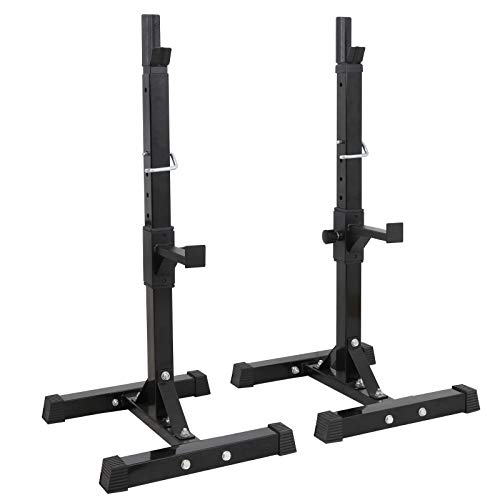
F2C’s independent stands address a different problem: you can move two small units out of the way when a shared room needs to return to normal use. Their spacing is adjustable because the uprights are separate. That flexibility also means you must set their alignment and position deliberately each time.
The listing advertises a 550-pound maximum and adjustable catches. Treat those as seller specifications, not independent proof of stability or protection during a failed lift. We would not choose these over a suitable cage simply because the advertised capacity appears generous.
Why buy them: storing a permanent cage is impractical, and you can verify the exact instructions, bench fit, catch arrangement and support needed for your training. Why pass: you are seeking a ready-made solution for heavy solo benching or cannot establish whether the catches cover your bar path.
Check the lower catch’s actual height and forward reach. A tall upper cradle is an unracking position; it is not the same thing as a suitably positioned safety catch. Do not rely on listing language that implies any adjustable stand guarantees protection without a spotter.
Check the F2C adjustable stand pair on Amazon →
Optional accessory: Titan independent bench press spotter stands

These are included separately because their name can confuse shoppers. They are low catch stands for an existing bench setup, not the main rack from which you unrack the bar. Titan specifies an adjustable height range of 23–35 inches and says they are not intended for squats.
They may be relevant if you already own suitable bar supports but need to assess an additional catch arrangement. Their 700-pound rating does not establish compatibility with your bench, bar path or lifting technique. Check the manual, actual catch position and complete setup before purchasing. If you are starting from scratch, compare the cost and space of a cage before buying separate pieces.
Check Titan bench press spotter stands on Amazon →
Power cage, half rack or independent stands?
A cage gives you a defined lifting area between uprights and a way to position full-length safeties. Independent stands give you flexible spacing and easier storage. A half rack falls between those layouts, but its safety-arm reach and installation requirements need their own checks.
Do not choose by category alone. Ask where the bar would go during an unsuccessful rep, whether the intended catches cover that path and whether the rack stays stable under the uses allowed by its manual. If you cannot answer those questions for a particular product, it is not ready for your shortlist.
For a gym that also needs a squat station, compare our home squat rack guide. For the bench itself, see our weight bench comparison. Buy these as a compatible system rather than selecting each item solely on its own rating.
The measurements to take before ordering
Bench base and rear clearance
Measure the feet and frame, not only the pad. The bench must reach a workable unracking position without its rear leg hitting a crossmember. An adjustable bench can change its base position when inclined, so check every configuration you plan to use.
Barbell fit and loading space
Compare the distance between the bar’s sleeves with the rack’s outside support width. The bar needs to rest correctly in both J-cups, with room to load plates on each side. A compact room can fit the rack while still leaving too little clearance for a full-length bar.
Safety height and adjustment intervals
The relevant question is whether the available catch settings work with your bench and your pressing range. “Adjustable” is not enough information. Follow the equipment instructions and get competent coaching if you are uncertain about positioning. A written buying guide cannot validate your individual setup.
Ceiling, floor and installation
Allow for assembly access, overhead fittings and any pull-up movement you intend to perform. Check the floor and the exact manufacturer’s stabilization requirements. A rack with bolt-down provisions and a rack designed without them need different installation decisions.
Compare the complete cost, not just the rack price
A bare rack price can omit the bench, bar, plates, floor protection, shipping and any required installation. Optional safety hardware and storage attachments can increase the total further. Start with the essential compatible setup, then decide which accessories you will actually use.
Check seller identity, return shipping terms and replacement-part support, particularly for bulky equipment. Keep the assembly manual and confirm that all supplied hardware matches its inventory. We do not publish fixed deal prices here because offers, colors and bundles change.
Frequently asked questions
Can I bench press in a squat rack?
Many racks can accommodate a bench, but compatibility is specific. Confirm bench clearance, unracking height, barbell fit, suitable catches and the manufacturer’s permitted use. The word “squat” neither proves nor rules out a workable bench setup.
Are independent stands enough for bench pressing alone?
Do not assume so. Upper cradles hold the bar for unracking; suitable protection during a failed repetition requires a separately verified catch arrangement. If that cannot be established, choose another setup and appropriate supervision.
Does a rack capacity include the bench and user?
Do not combine different ratings that way. Rackable load, whole-rack load, safety capacity and bench total-load capacity can refer to different conditions. Read each manufacturer’s definitions and follow the applicable limits for the complete system.
What ceiling height does the Titan T-2 need?
The linked model is the 83-inch variant, not the 71-inch version. Confirm its drawing and leave the additional clearance needed for assembly and intended use. The nominal frame height alone is not a complete room-clearance requirement.
How tall is the REP PR-1100?
The linked Amazon listing says 80.5 inches, while REP’s current page says 85 inches. Confirm the specific supplied version before ordering. If you have a low ceiling and cannot resolve the discrepancy, do not buy on the assumption that the shorter number applies.
Are Titan spotter stands a full bench press rack?
No. The low independent spotter stands in this guide are a catch accessory. You still need appropriate supports for unracking, and Titan says these spotter stands are not for squats.
Sources and selection method
Checked on 3 November 2026 using current Amazon product data and the official Titan T-2, REP PR-1100 and Titan spotter stand pages. F2C details are attributed to its Amazon listing because an equivalent manufacturer specification could not be established. We flag conflicting information rather than silently choosing the most convenient number. These comparisons are editorial judgments, not independent product certification.
This article was last updated on November 10, 2026 .


