

The best portable treadmill depends on what you need to move. If you need to clear the floor after a walk, the WalkingPad P1 folds across the deck and fits into a much shorter space than a typical under-desk treadmill. If you want a removable handrail, compare the WalkingPad Z1R. If you want to jog or run with a fixed console, choose a deck-up treadmill such as the XTERRA TRX1000 or the larger TR75. Both of those reclaim floor length when folded and are better treated as equipment you move a short distance in the same room.
Start with your intended pace and storage location. A machine that folds under furniture may be too short for your running stride. A treadmill that gives you room to run may need a tall, dedicated parking space. The best compromise is the one that still lets you do the workout you bought it for.
Affiliate disclosure. As an Amazon Associate, The Fitness Blog earns from qualifying purchases. We checked the exact US Amazon listings on November 8, 2026. Offers and availability can change.
The best portable treadmills compared
| Model | Best for | Key detail | Main tradeoff |
|---|---|---|---|
| WalkingPad P1 | Fold-in-half walking | 3.75 mph max, 5 inches high folded | 62 lb and no fixed rail |
| WalkingPad Z1R | Walking with an optional handrail | 5 mph listed max, removable rail | Rail adds a setup step |
| XTERRA TRX1000 | Compact console treadmill | 16 × 50-inch belt, 10 mph max | Manual incline and upright storage only |
| XTERRA TR75 | More room for running | 20 × 60-inch belt, 12 mph max | Much larger, even with the deck folded |
Amazon bestsellers for portable treadmills
This Amazon bestseller display is separate from our editorial picks. Check the exact model, folded measurements and intended walking or running use before choosing from it.

- Versatile Fitness Solution: This multifunctional treadmill combines walking, under desk running, and...
- Powerful Yet Quiet Performance: With a 2.5HP servo motor, this treadmill delivers speeds from 0.2 to 3.8...

- 2.5HP Powerful Motor: The treadmill is equipped with a powerful 2.5HP motor and offers a large weight...
- 2 in 1 Walking Pad: Stay active throughout the day with our 2-in-1 portable treadmill. The speed of...

- 【3 Level Incline Treadmill】YPOO walking pad with handle bar offers a unique 8% manual incline,...
- 【2 In 1 Foldable Treadmill】YPOO treadmill offers a speed range from 0.8-8.0KM/H(0.5 to 5.0MPH). When...
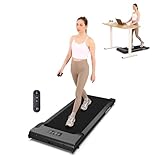
- 【Whisper-Quiet Operation】Utilizing 2.5HP brushless motor, our walking pad runs super quietly,...
- 【Dual Shock Absorption】 Equipped with both suspended shock-absorbing deck and high-performance TPR...

- 【Advanced 2.5HP Brushless Motor】Our walking pad treadmill features an advanced 2.5HP brushless motor,...
- 【Optimal Shock Absorption】Equipped with dual shock absorption technology, our walking pad treadmill...
Which compact treadmill suits your room?
WalkingPad P1 · Fold-in-half walking

Check WalkingPad P1 on Amazon US
The P1 is the first model to compare if the hardest part of buying a treadmill is putting it away. The manufacturer’s P1 specifications give a folded footprint of 32.5 by 21.5 inches and a height of 5 inches. Unfolded it is about 56.5 inches long. The fold saves storage length while keeping a usable walking surface of about 47 by 16.5 inches. The US model plugs into an outlet and supports a manufacturer-listed user weight of 220 pounds.
The P1 has a 3.75 mph listed top speed. It is for walking, including light walking at a suitable standing desk. There is no fixed handrail. People who want a rail every time they step onto a moving belt should compare the Z1R with its rail installed, or look at a treadmill with a fixed support and console.
The compact folded dimensions do not make the P1 light. WalkingPad lists its net weight at 62 pounds. If you plan to slide it on its wheels between a sofa and an open spot, mark out that route. Carrying the treadmill up a flight of stairs or lifting it into storage before every use is a very different job. Check the minimum height along the furniture opening, including any center brace, before assuming a five-inch deck will fit.
WalkingPad Z1R · Walking with an optional handrail

Check WalkingPad Z1R on Amazon US
The WalkingPad Z1R is for someone who wants the short storage length of a fold-in-half deck and the option of a handrail. The manufacturer lists a removable rail and a top speed of 5 mph. The standard Z1 and Z1R are separate products. Compare the exact listing rather than using a review of the rail-free Z1 as a substitute.
A removable rail makes the most sense when the unit spends most of its time in one configuration and you occasionally change it. If you want to move frequently between under-desk walking and rail-equipped exercise, look at the rail removal procedure first. Extra hardware to detach and store can make an otherwise small machine inconvenient. Use it only in the configurations and speed ranges allowed by the manufacturer.
Consider the Z1R for regular walking when you prefer a handrail available. If running is the reason you are buying a treadmill, evaluate the belt length and width at your normal stride before treating the top speed as the deciding factor. The larger XTERRA models provide more room for that use. The P1 is simpler when a rail is unnecessary and you mainly want to recover floor space.
XTERRA TRX1000 · Compact console treadmill

Check XTERRA TRX1000 on Amazon US
The TRX1000 is the compact console treadmill in this group. XTERRA specifies a 16-by-50-inch belt, a 0.5–10 mph speed range and a 250-pound user limit. It has a lift-assisted folding deck and three manual incline settings. The TRX1000 product page provides the complete dimensions and links to the owner’s manual. Confirm that the Amazon offer names the TRX1000. It is distinct from the older TR150 and the similar TR200.
It takes up roughly 64 by 29.5 inches of floor area while set up and folds to about 28.7 by 29.5 inches, with a height of around 61 inches. At 103.6 pounds according to XTERRA, it makes more sense as a machine you fold in a room than one you transfer between floors. The folded size also rules out typical under-bed storage. Check that the lift path clears shelves, walls and the room’s light fittings.
The belt is shorter and narrower than the TR75’s. It makes sense for walking and for jogging if your stride fits comfortably on it at your intended pace. A top speed of 10 mph gives a ceiling, not a guarantee of a comfortable run. Manual incline means choosing a setting before exercise according to the instructions. If changing incline mid-session is part of your plan, compare the TR75 instead.
XTERRA TR75 · More room for running

Check XTERRA TR75 on Amazon US
The TR75 is the better fit here for a runner who needs a wider and longer deck and still wants the floor length back after a session. The XTERRA TR75 specifications give a 20-by-60-inch running surface, speeds up to 12 mph, power incline and a lift-assisted fold. The larger running area is the main reason to step up. The controls and incline matter if you use them, but a belt that fits your stride matters every time.
This is a substantial machine even when folded. XTERRA’s TR75 dimensions give a folded footprint of about 50 by 35 inches and a height around 66 inches. Plan to set it up in the room where it will stay. Measure the delivery route and check the seller’s delivery and assembly terms, especially if there are stairs or a turn at the landing.
For a walking-only apartment setup, it is more equipment than you need. For regular running, a larger deck makes more sense than buying the smallest possible model and trying to adapt your stride to it. Measure ceiling height and check the user’s weight against the manufacturer limit for the exact unit before ordering. Confirm the storage position still leaves enough room to pass by without catching the console or rail.
How to measure for a folding treadmill
Measure three spaces, including the route between them
First measure the treadmill’s operating area. Add the rear and side clearance specified in the owner’s manual to the machine’s open footprint. Keep that space away from doors that swing open, tables with sharp edges and furniture that would obstruct you stepping off. The small footprint on a product page is only the frame. It does not tell you how much room you need to use the machine.
Next measure the storage opening. For a unit that slides under furniture, measure the lowest point along the route, including frame supports and floor transitions. For a deck-up treadmill, measure how far it stands from the wall and how high the deck rises. Check nearby shelves, window ledges and anything that might interfere while the deck moves. Use only the storage orientation approved for the exact model.
Finally measure the route to storage. A low machine might fit beneath a couch but be hard to rotate in the space in front of it. A deep rug edge can make transport wheels awkward to use. A treadmill that parks in the same room is a much more realistic option than one that needs to cross a threshold or be carried down a hallway after every walk.
Check headroom, especially on an incline
Compare your height in workout shoes with the available ceiling height, then allow for the deck step-up and the highest incline position you will use. Consider overhead lights and beams, not just the nominal ceiling height. Use the manual and ask the manufacturer for the exact clearance if the space is marginal. A flat walking pad and a raised treadmill deck put your head at different heights in the same room.
If you plan to use a standing desk, add the deck thickness to your usual standing height when setting the desk. The treadmill raises you relative to the keyboard and monitor. Check that the desk can move far enough up without the controls, crossbar or screen support getting in the way. Arrange cords so you can move the machine without dragging them.
Plan power and controls before delivery
Check the exact model’s outlet and grounding requirements and put the machine where its supplied cord can reach. Follow the manual’s instructions on extension cords and power strips. Think through where the plug, power switch and safety control will sit once the machine is open. A socket behind a heavy console might be hard to reach when the treadmill is in use. For a pad that relies on a remote, check whether you can order a replacement and what controls are available on the machine itself. Those details matter more in daily use than an extra display mode.
Match the treadmill to the workout
Walking while working
For under-desk use, prioritize a low starting speed, easy-to-reach controls and a comfortable belt width. Begin at a pace where you can walk naturally without leaning on the desk. A treadmill that allows a brisk walk is not necessarily comfortable for detailed typing. Experiment with walking during reading or calls first. Keep the remote or stop control within reach and stop before changing the desk position.
Compare the unit’s external width with the width between the desk legs. Check how the motor housing, handrail if fitted and controls fit around the front of the desk. Our guide to fold-flat under-bed treadmills focuses more closely on low storage clearance. If your space is exceptionally shallow, use the measured storage height as your first filter.
Jogging and running
Measure belt dimensions before comparing motor claims or preset programs. A runner who wants more room to move should compare the TR75’s 20-by-60-inch surface with the TRX1000’s 16-by-50-inch deck. Longer strides and faster paces generally increase the importance of having extra room. When practical, try a treadmill with similar belt dimensions before ordering. Test the pace you actually intend to run, not the maximum speed printed on the box.
Pick a treadmill rated for your intended use and user weight. Follow the manufacturer’s power, placement and safety instructions. If a treadmill includes a safety key, use it as directed. Keep people, pets and loose items away from a moving belt and follow the manufacturer’s directions for disconnecting power and securing the machine after use. Ask the seller about parts and service as well as the warranty headline.
Noise in shared rooms
Separate machine sound from footfall and vibration. A walking pace can be acceptable in a shared room even when running on the same floor is disruptive. Floor construction and where you place the treadmill affect how much vibration reaches another room. Generic quietness claims are hard to compare without consistent measurement. A suitable level mat can protect the floor where the manufacturer allows one. It cannot guarantee that downstairs neighbors will hear nothing.
Check the return policy if noise is likely to decide whether you keep the machine. Large treadmills can be difficult to repack and may have different return conditions from small items. Keep the packaging until you have confirmed the fit and basic operation, following the seller’s instructions. Our quiet treadmills guide covers more options for shared spaces.
How we chose these portable treadmills
We compared exact US offers with manufacturer documentation and assigned each pick a different job. The P1 and Z1R address walking in a room that needs its floor space back. The TRX1000 and TR75 address conventional treadmill use with an upright folded deck. We considered belt size, storage, power and speed, then highlighted the compromise each design asks you to make. The comparison is based on documented specifications and listing checks. Product marketing about noise and workout outcomes does not substitute for evidence in your room.
Frequently asked questions
Are portable treadmills cordless or rechargeable?
The four models here use wall power. A battery in a remote control does not power the treadmill belt. If a product is advertised as cordless, verify in the manual what the battery powers. A curved or other manual treadmill may operate without electricity, but that is a separate design with a different feel, footprint and often a substantial frame.
Can I store a foldable treadmill under a bed?
Some walking pads can fit if the opening is high and deep enough and the manufacturer permits that storage position. Measure the lowest obstruction under the bed. The P1 is listed at about 5 inches high folded, and you need a practical margin to slide it in. A conventional deck-up unit such as the TRX1000 or TR75 stores vertically as a larger assembled machine.
Does a 10 mph top speed mean a treadmill is suitable for running?
Top speed is one part of the decision. Check the manufacturer’s intended use and look at the belt width and length, the controls and how much space you have to move. Some people can jog comfortably on a compact console treadmill. Frequent runners may prefer the longer and wider TR75 deck even if they never use its maximum speed.
What is the difference between a walking pad and a folding treadmill?
A walking pad is usually a low-profile motorized unit for walking, sometimes with a fold across the deck. A conventional folding treadmill usually has an upright console and a deck that tilts up to reduce its floor footprint. Compare the exact open and folded dimensions. The word folding can describe both designs and does not tell you where they will fit.
Can I move a portable treadmill between rooms?
A small pad with wheels may be practical to roll across a level floor if the manufacturer permits it. Check the machine’s weight and the route before deciding you can lift it. A console treadmill is generally best positioned in the room where it will be used. Folding the deck makes it easier to store and does not make the machine light.
Is a handrail worth having on a small treadmill?
A handrail is useful if you want a fixed point nearby when getting on, stopping or adjusting your pace. A removable rail, such as the Z1R’s, suits people who also need an open under-desk configuration. Choose a fixed console treadmill if you want a conventional rail and controls every time. Follow the exact model’s setup and use instructions.
Should I buy manual or power incline?
Manual incline works when you can choose the position before you start. Power incline is the better match when you want to adjust the slope during a session. If your main use is low-speed desk walking, an incline mechanism may add complexity without helping the job you have in mind. Spend first on the belt fit and storage you need.
The bottom line
Choose the P1 for compact storage and walking, the Z1R if a removable handrail matters, the TRX1000 for a compact conventional treadmill or the TR75 for more running room. Write down your open footprint, folded space and normal workout pace before buying. If the equipment fits those three constraints, you will get more use out of it than from a machine chosen on the strength of the word portable alone.
This article was last updated on November 8, 2026 .


