

For most home gyms, buy a 30-foot, 1.5-inch rope and spend the rest of your setup budget on a sound anchor and a surface the rope can travel across. The covered Yes4All kit is the first one to consider if you have roughly 15 feet from anchor to hands, plus room to move. Choose the 50-foot Titan if you have a clean lane and want a bare rope. Choose the 50-foot REP if that lane sees frequent use and a full sleeve is worth the extra bulk.
As an Amazon Associate, The Fitness Blog earns from qualifying purchases. We compared exact sizes and kit contents with manufacturer information and checked the linked US offers on November 14, 2026. Availability can change. The recommendations compare specifications and setup requirements, with no hands-on test scores.
Compare the picks
Swipe to compare on smaller screens.
| Battle rope | Length and grip | Cover | Best fit |
|---|---|---|---|
| Yes4All Covered Battle Rope | 30 ft × 1.5 in | Full sleeve | First garage setup |
| Titan Black Poly Dacron Battle Rope | 50 ft × 1.5 in | Bare braid | Long rubber or turf lane |
| REP Sleeve Battle Rope, Red | 50 ft × 1.5 in | Full sleeve | Frequent use on a long lane |
The five bestselling battle ropes on Amazon
This automated list shows popular listings. Use the specs and space checks below to compare the exact sizes, since a bestseller may open on a different variant from the one you want.

- The 3-strand thick training rope is made of durable polyester blend; high tensile strength prevents...
- Heat-shrink ends which make the Workout ropes more convenient to hold and will offer a better grip when...

- 💪【3 Types of Length, 1.5 inch Diameter】30ft. 40ft and 50ft. length available for 1.5” ropes,...
- 💪【Upgraded Durable Protection Sleeve】Upgraded Durable Protection Sleeve, Wear Resistant and...

- Battle Rope with Durable Polyester Filament Material: An extra protective cover is added to the outer...
- Workout Rope Includes Gloves and a Sweat Head Towel as a gift: In order to prevent palm bruises or...
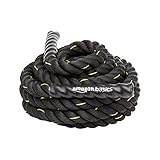
- Black 30 foot, 1.5 inch diameter battle rope
- Material: 100% Poly Dacron, Wear Resistant and Durable, 3-Strand Twisted Polydactyl Strong Construction

- 【Double-layer Protection】: The battle rope adopts double-layer nylon protective cover, which better...
- 【100% Polyester】: More durable and heavier than a blend of PolyPro and PolyDac materials, Matching...
Which battle rope fits your space?
Start with a tape measure. A single rope folds around its midpoint, leaving approximately half the advertised length in each hand. The anchor bend, attachment strap and slack shorten the straight line a little, but planning on the full half length is a better starting point than counting on a tight fit. Measure to where your hands will be and leave room behind your feet, beside your arms and around the rope path. A room that measures 16 feet wall to wall rarely gives you a clean 15-foot working lane.
A 30-foot model fits many garages once the car is out. A 40-foot rope is the intermediate option if you can use about 20 feet plus clearance and want more rope to move. A 50-foot model calls for about 25 feet before clearance and suits a long garage bay, turf strip or open yard. A diagonal can provide extra length, but check the entire swept area for shelving, bike pedals and anything that might catch a handle. If there is no reliable anchor or clear travel path, a compact conditioner such as a mini stepper is easier to set up.
Diameter affects how your fingers close around the handle and how much rope you have to move. At the same length and construction, a thicker build generally makes each wave harder to start. But a 1.5-inch sleeve can weigh more than another brand’s bare rope of the same size. Look up masses for the exact variants if you are sensitive to weight. Grip size should leave you able to hold the handle without squeezing at maximum effort through every interval.
Yes4All Covered Battle Rope

Check Yes4All Covered Battle Rope on Amazon · Manufacturer specifications
This kit makes the most sense for a first garage setup. The linked version is 30 feet long and 1.5 inches in diameter, with a protective cover, steel anchor and strap. You get the key pieces in one order, which is useful when comparing it with a bare rope listing and a separate hardware purchase. The seller has several almost identical titles. Verify that the variant explicitly says covered and includes the anchor and strap before checkout.
A full cover is most valuable along a route that sees regular friction, especially close to the anchor, where the rope repeatedly bends. It also makes the rope less pleasant to drag and harder to inspect all the way along the core. Uncoil it before buying additional hardware, confirm how the strap actually fits, and inspect the ends and visible seams before working it hard. The included mount needs a suitable structure and installation according to the instructions. Drywall or an unsecured rack can move or fail under repeated loads.
This would be my pick for someone with one place to train and one rope to buy. On a short lane you can get useful practice without committing to the mass of a 50-footer. The main reason to step up is access to more clear floor plus a specific preference for longer waves. An extra ten or twenty feet does little for someone who has to coil the rope close to the anchor just to make a session fit.
Titan Black Poly Dacron Battle Rope

Check Titan Black Poly Dacron Battle Rope on Amazon · Manufacturer specifications
Titan’s linked poly Dacron version is a bare rope, 50 feet long and 1.5 inches thick. It works best on rubber flooring or turf where the unprotected strands have an even surface. The chief appeal is the same reach as the sleeved REP with the simpler construction of a bare rope. You can see the exposed braid for inspection, and there is no outer jacket to manage as you coil it. Plan for an anchor separately and check what the selected package actually ships with.
A long rope gives you more distance to see whether waves are making it to the anchor. This is useful when you want to practice a steady rhythm instead of driving hard for a few seconds. It does not mean you have to throw the handles higher. A smaller repeatable wave is often a practical starting point. If the far half keeps lying motionless, check slack and obstructions before assuming you need to pull harder. In a short room, exchanging the rope for a shorter model is more useful than trying to train around furniture.
Titan also sells thicker and shorter variants. The linked offer is the specific 50-foot, 1.5-inch version. A buyer shaping a cross-training lane with a wide range of users should think carefully before selecting 2 inches. It can turn a conditioning station into a grip station for the smallest hands in the group. If you have only one anchor and a mix of users, choose a size the least experienced user can control.
REP Sleeve Battle Rope, Red

Check REP Sleeve Battle Rope, Red on Amazon · Manufacturer specifications
REP publishes a weight of 28 pounds for this 50-foot, 1.5-inch sleeved configuration. It is a sensible choice for a shared lane where the rope goes down and comes back up often, with a jacket that takes surface wear. REP also offers a 30-foot sleeved version and thicker builds. The linked Amazon listing is specifically red, sleeved, 50 feet and 1.5 inches. Black in the same family may be the bare version, so do not match by color alone.
A protective sleeve is a reason to buy this model if you have the space to leave it set up or a convenient way to store it. It is not permission to run the rope across rough concrete, sharp edges or a doorway threshold. REP recommends turf or rubber. Pay particular attention at the anchor bend, where even a smooth strap can rub if the rope shifts sideways. A sleeve might make visible wear look less obvious at first, so check seams and any localized thinning.
The downside is carrying and storing a long, covered rope, especially if your training spot is outdoors and your storage is at the other end of the house. Before buying, work out whether you can hang loose coils or lay them somewhere dry without crushing the handles under other gear. A short rope that is easy to deploy usually gets more use than a premium long one that takes time to move.
Set up an anchor before the rope arrives
Check the shape and direction of the load. Battle ropes tug and vibrate mostly toward the user. A mount that is fine for a light resistance band may be unsuitable for repeated force from a heavy rope. Choose hardware designed for that use and match its installation to the supporting material and the manufacturer’s instructions. If you use a strap around a structure, protect the strap from sharp edges and make sure it cannot ride up or slide off. Use a rack only if its manufacturer permits the attachment and the rack is secured for the task.
Mark the midpoint before threading the rope so the ends are even. Start with a gentle bend and a little slack in each half at your normal stance. A line pulled almost straight is harder to wave and tugs on the anchor. An excessive loop pools at your feet and can trip you if you step around it. If the ends are uneven, reset the middle instead of standing diagonally to compensate.
Think across the lane as well as along it. Set out the path so a person walking into the garage does not step between the handles and the anchor. Avoid putting the anchor just beyond a parked car or open door, even if that gives enough straight-line distance. Inspect the flooring for loose mats that can creep together or fold as the rope crosses them. And if the anchor sits on a rack, check that the cable and handles cannot reach weight horns or the ends of a barbell.
Garage, patio and shared-space setups
For a garage, rubber flooring reduces abrasion and keeps the strands from catching on an uneven joint. Put the anchor where both rope legs can run on the same surface. A good compact setup may mean turning a loose mat, moving a bench or leaving the back wall clear, rather than using the longest possible diagonal. Store dry rope off the floor if the garage puddles or collects grit. In a gym with limited trip-free floor space, put the rope away before resuming lifting.
For a patio, look for a permanent anchor you are allowed to use and somewhere dry indoors to put the rope afterward. A cover helps with abrasion but does not make a rope weatherproof. Lay it out to dry after a damp session before coiling it. Leaving wet coils in a sealed bin traps moisture and makes early wear harder to spot. If there is no turf or other suitable surface, check a different conditioning option before paying for a covered rope you would still be dragging over rough aggregate.
For a shared building, check the rules before drilling and consider where impact and vibrations travel. Alternating low waves tend to be a more practical choice than repeated slams if the room is beside a living area. Even a short rope needs enough space to keep others out of the lane. A portable tool with no anchor, such as an adjustable kettlebell, can suit a small room if you are mainly looking for short conditioning sessions and can train safely with that movement.
Try a first session after checking the setup
Start with several easy waves before timing anything. Hold one end in each hand, with your feet comfortably apart, knees relaxed and hands slightly in front. Move one hand up while the other comes down and keep the waves low enough to repeat. Let your shoulders settle between efforts. Alternate hands for a few seconds, then stop and inspect whether the midpoint has moved. That small check is worth doing whenever you change anchors or switch to a heavier rope.
When you know the setup is stable, use several short work bouts with longer rests. For example, alternate waves for 10 to 15 seconds, rest for 45 to 60 seconds, then repeat several times while the waves remain even. The point is to learn a rhythm you can repeat. A timer is optional. If you lose control of a handle, feel joint pain or start hauling the rope with your back, stop and reset instead of extending the bout. Anyone unsure about training around an injury should get individual guidance before trying hard intervals.
Once both sides produce similar waves, try moving the hands together at a controlled height. The rhythm and force feel different even with the same rope. Use that difference to progress the movement before buying a thicker model. A small step forward usually gives more slack. Work out how much slack the cleanest waves need and mark your stance if several people train from the same anchor. Leave side-to-side movement and slams until you have the space and control to keep both ends in the lane.
Make the next progression measurable
Keep the length, diameter and anchor position fixed, then change one session variable. For example, increase repeatable work time slightly or reduce rest a little while keeping your wave height roughly the same. If the later waves barely travel, the earlier bouts may have been too hard. Mark the floor at your starting position and use it again next time. This makes a short rope useful for many sessions because progression is about repeatable work as well as equipment size.
Think about where rope work belongs in the session. Doing it before heavy pulling can fatigue your grip and change how you train with a barbell or weights. It may fit better after lifting or on a separate day. If you are using it in circuits, put the handles down without crossing the next station’s path. Keep a little rest while moving between stations so you can reset the rope rather than picking up one end wound around the other.
FAQs
Can I use a battle rope without drilling a hole?
Yes, if you can use the manufacturer’s strap configuration on a suitable permanent anchor or a properly secured rack approved for that use. A freestanding item that slides during easy waves is unsafe at a higher effort. Test lightly and stop if you see movement, wear or hardware changing position. If your building has no appropriate anchor point, choose conditioning equipment that does not pull on the structure.
Is 30 feet enough for conditioning?
Yes. A 30-foot rope gives two legs of roughly 15 feet, which is enough to practice alternating and double waves and build repeatable intervals. Your working effort depends on the rope mass, diameter, movement and work-to-rest pattern. Choose 50 feet for a deliberate change in wave feel or a longer permanent lane, not simply because the longest variant is available.
Should I buy a 1.5-inch or 2-inch rope?
Start with 1.5 inches for a first rope or for mixed users. A two-inch grip is harder for many people to hold and usually means more rope to move. It makes sense if the buyer wants that deliberate grip and rope-mass challenge, has space for the chosen length and is already comfortable controlling a narrower rope. Check the exact construction and product weight before comparing brands.
Do I need a sleeve for outdoor training?
A sleeve is useful when you train often and want a wear layer over the braid. The surface, anchor shape and storage habits still matter. Avoid sharp curbs and uncovered concrete edges, even with a jacket. If you train only occasionally over smooth rubber, a bare rope may suit you. Pick the surface first so you know what the cover actually has to protect against.
Can short ropes replace longer ones for group classes?
They can be a better match when the goal is to rotate several people through short stations. Think about how many lanes can fit and whether each user can grip and control the rope. A shorter, thinner model tends to make it easier to leave safe walking paths. If a class regularly uses longer ropes, schedule that work where there are enough separate anchors and room for each rope’s full trajectory.
When should I retire a rope?
Stop using one with a separating handle, torn strap, damaged mount, exposed core in places where the cover should protect it, or a braid that has begun to part. Inspect more often around the midpoint and where the rope passes from one surface to another. Keep the instructions so you know how the brand expects you to check for damage and which components can be replaced.
Battle rope workout demonstration
The buying decision in one pass
Measure the lane and choose the anchor before looking at rope construction. If there is room for about 15 feet of rope plus clearance, start with the 30-foot covered Yes4All. If the lane is long and protected, the bare 50-foot Titan is a straightforward choice. If the same long lane will see frequent use and you prefer a cover, pick the red sleeved REP. Check the chosen variant one more time at checkout, especially length, diameter and included hardware.
This article was last updated on November 14, 2026 .


